MIDLIFE ALCHEMY
The research and why it matters…
this is the research i wish existed when i needed it most
Because being a midlife woman myself taught me that the research had been asking the wrong questions. Not what the textbooks say they should experience. Not what the medical system has been designed to measure. What is actually happening in the body, the mind, the relationships, and the inner life of women between 40 and 60?
If you are in midlife, you may have noticed that the world (and social media) has a great deal to say about you and very little of it captures how it actually feels from the inside.
The medical system tends to focus on what’s declining: hormones, bone density, metabolic function. The wellness industry offers you supplements, programs, and the promise of getting your body back. Popular culture swings between dismissing midlife women entirely and celebrating them with a kind of relentless positivity that, if you’re honest, doesn’t quite match your inner experience either.
Most of the research that exists on midlife women was designed by people who were not midlife women. It measures what researchers thought to measure, largely biological markers and largely misses everything that sits underneath: the identity questions, the relational shifts, the strange mixture of loss and liberation, the growing sense that something is being asked of you that you don’t quite have language for yet.
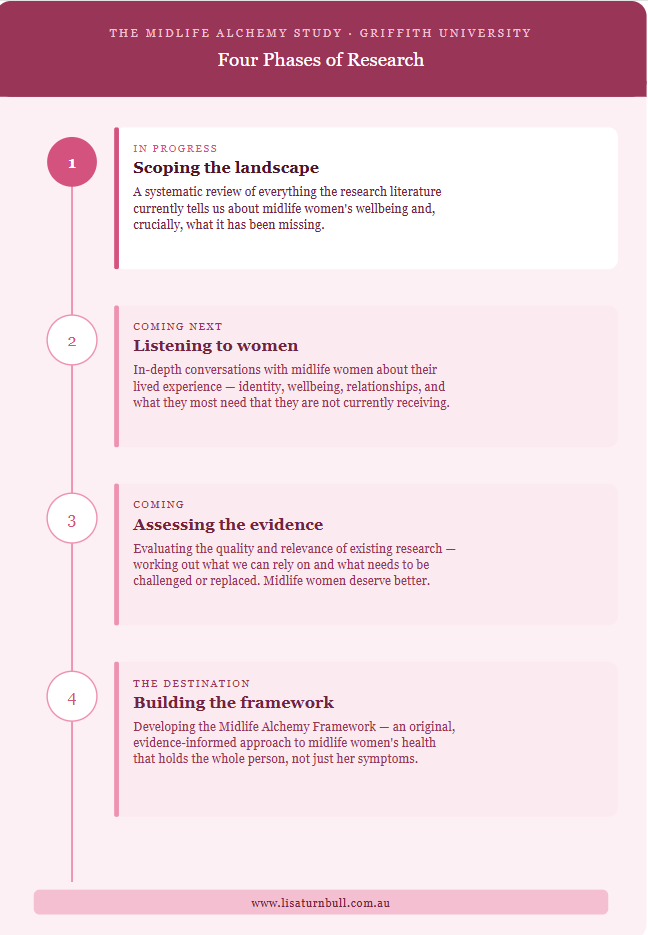
The Midlife Alchemy study exists because after 25 years of sitting with midlife women in therapy rooms, on retreats, and in supervision, I became convinced that what they were telling me deserved to be taken seriously, not just as anecdote, but as evidence.

About the researcher
I am not a detached observer of midlife. I am living it, in all its complexity, its beauty, and its difficulty.
In the past few years, I have watched my children begin to leave home, felt the particular silence that follows and quietly grieved something I wasn’t quite prepared for. I have stepped more deeply into caring for ageing parents, holding their vulnerability alongside my own shifting sense of who I am now that some of my primary roles are changing. I have felt my responsibilities reorganise themselves in ways I didn’t choose, and have discovered that I am not as resilient to stress as I once was, or perhaps as I once believed myself to be.
My body has offered me its own education. I have navigated new-onset hormonal migraines that arrive without warning and leave me horizontal. I have sat with the brain fog that makes a sharp mind feel suddenly unreliable, the reaching for words, the half-finished thoughts, the strange vertigo of not quite trusting my own cognition. I have felt the frustration of doing all the right things and still feeling like I am functioning at partial capacity.
None of this has made me less capable of doing my work. But it has made me acutely, personally aware of how little support exists for women navigating this terrain and how much of what does exist addresses the surface while leaving the deeper experience untouched.
I have also been sitting with midlife women in therapy rooms, on retreats, and in supervision for 25 years. I have heard thousands of versions of the same story: a woman who is capable, intelligent, and self-aware doing everything she is supposed to do and still feeling like something essential is not being addressed. Not by her GP. Not by the wellness industry. Not by the research literature, which has largely been designed around what clinicians assumed mattered, rather than what women actually experience.
What I hear in those stories, and what I recognise in my own, is not pathology. It is a woman in the middle of a genuinely significant life transition, without a map, without adequate language, and without a health system designed to hold the whole of what she is going through.
This research is my attempt to take that experience seriously, not just as a clinician observing it in others, but as a woman living it herself. To bring the rigour of academic research to bear on the questions that matter most to women in midlife. And to build something a framework, a language, a body of evidence that can genuinely help.
I started this PhD because I couldn’t keep sitting with women in pain and not doing something more than holding the space. I wanted to understand what was missing not just intuitively, but evidentially. I wanted to be able to say, with research behind me: this is real. You are not imagining it. And here is what we know about how to actually help.
To the women who have trusted me with their inner lives for over 25 years, you deserve research that is worthy of the experience you have been navigating largely without adequate support. I believe this so deeply that I am going to spend years studying it.
Lisa x